For more than a decade, the d.school’s social impact team has been on a mission: help social sector leaders — from nonprofit innovators to government changemakers — design solutions that truly improve people’s lives. After years of working with nonprofits and social sector leaders, Nadia Roumani, senior designer, and Thomas Both, director of social impact programs, identified a universal need: tools for better project scoping.
The first step in design work
In our workshops and coaching sessions, the team noticed that while many leaders already know how to use design tools like interviews and prototyping, they often struggle to apply them in real-world settings, where complexity, limited resources, and competing needs can easily overwhelm even the best intentions. Over years of working with hundreds of practitioners, one truth became crystal clear: how you start matters as much as what you do.
A critical first step? Scoping — designing your design work.
Why scoping is so powerful
In most fields, a “scope of work” describes the outputs you’ll deliver. But in human-centered design for social impact, scoping is something different — and counterintuitive. It’s not about naming the thing you’ll make; it’s about clarifying what you need to learn to get to the right solution.
“Instead of saying, ‘We’re going to build a website,’ you’re defining, ‘Here’s what we’re trying to understand, here are the assumptions we want to test, and here’s who we need to learn from to understand what we should build,’” says Thomas.
Good scoping does three essential things:
- It focuses the work on the most important questions and opportunities;
- It aligns team members on goals before jumping into research or prototyping;
- And it ensures limited resources are spent on efforts with the greatest potential for real change.
Scoping is especially crucial in the social sector, where practitioners face tight timelines, tight budgets, and a dizzying number of possible directions. Without a clear scope, design efforts can become “wayward” — collecting lots of insights without a clear plan for using them. In fact, practicing human-centered design without intentional scoping can be frustrating and even harmful in needs-rich environments where trust and resources are on the line.
Scoping at the intersection of strategy and design
Scoping sits in a sweet spot between strategy (where you set the vision and intended impact) and design (where you explore and iterate your way to the solution).
“Strategy is knowing where you want to go; design is having the humility to know you still need to discover the path to get there,” explains Thomas. “Scoping connects the two, it helps you set up your design work so it’s as impactful as possible.”
It’s a skill we’ve honed over years of coaching. In workshops, we often spent more time helping participants figure out what to apply design to than on the design activities themselves.
The birth of Scopey
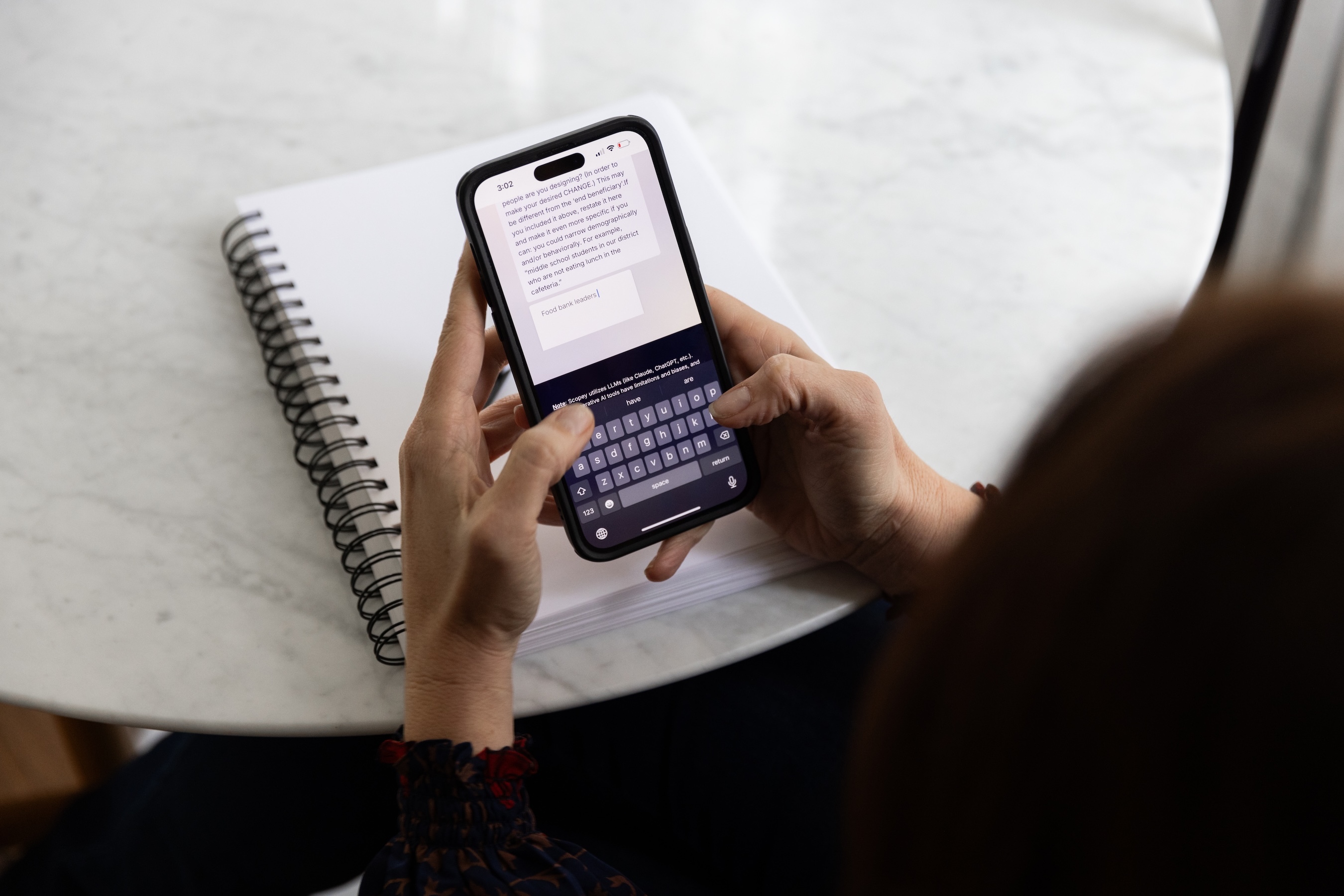
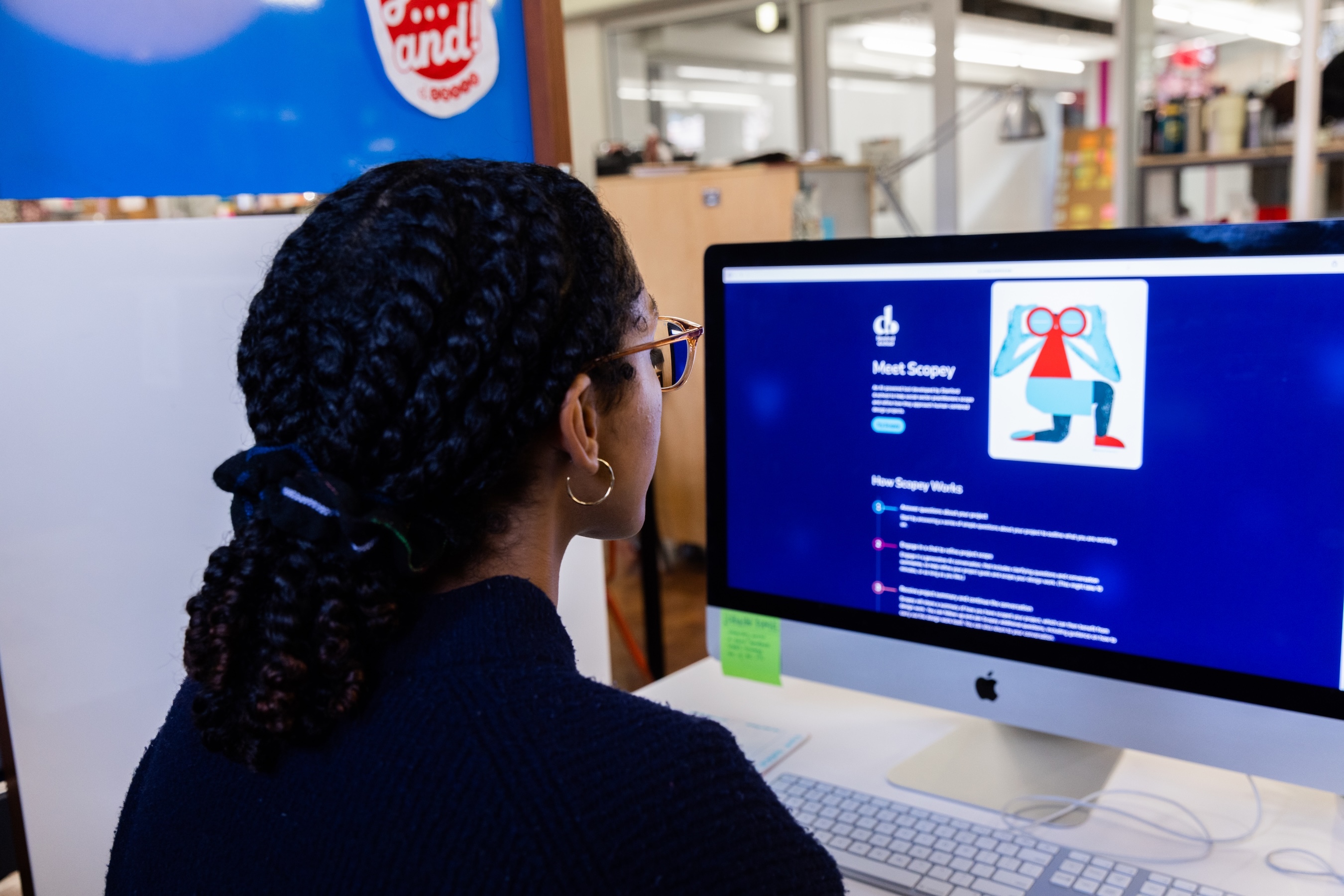
That pattern sparked an idea: what if there were a tool to help anyone, anywhere, scope their design work similar to a live coach ? Enter Scopey, an AI-powered scoping assistant.
“We designed Scopey to replicate the coaching conversation we’d have with a practitioner — asking clarifying questions, challenging assumptions, and narrowing focus,” says Nadia . “The magic isn’t in giving you an answer. It’s in guiding you through a dialogue that brings clarity out of the chaos.”
The team imagined a tool that could act not as an answer machine, but as a thoughtful guide, one that pauses with you to reflect, challenge assumptions, and find focus before diving into solutions. Built in partnership with Enchatted, Scopey began as a set of prototypes tested with d.school alumni. The team refined it based on feedback, added dynamic AI capabilities, and launched it to the broader public.
How Scopey works
Scopey starts by asking a deceptively simple question: What change are you trying to create? From there, it helps you:
- Identify who you’re designing for, not just broadly (“all high school students”), but specifically (“students transitioning from middle to high school in rural districts”).
- Surface and articulate your assumptions about those people and their context.
- Define the questions you need to explore through design.
- Align your team on goals and learning priorities before starting.
In other words, instead of jumping into What will you make?, Scopey starts with What do you know now? and What do you still need to understand? The result is a clear, intentional design scope — one you can use solo, with a partner, or across a team to compare perspectives and build alignment.
AI that crafts a conversation rather than provides answers
While many AI tools deliver quick answers, Scopey’s value lies in the conversation. It behaves more like a thoughtful coach than an all-knowing oracle.
“People are used to AI as a shortcut, or to speed things up,” says Nadia. “But Scopey is about slowing down just enough to get the clarity you need. That clarity lets you go faster and be more effective once you start the design work.”
In doing so, Scopey acts as scaffolding for your design work.
From workshop tool to global resource
Scopey is now a popular feature in the d.school’s Design for Social Impact workshops, where participants bring their own real projects to advance (over the five weeks). They use Scopey in the first week to set themselves up to apply design, equity, systems, and strategy practices.
But it’s also free for anyone to try. And we’re eager to see where it travels.
Already, users have applied Scopey to:
- Redesign community services.
- Align new teams around shared goals.
- Orient newcomers to a project’s design approach.
- Train other organizations in scoping as part of broader capacity-building efforts.
Why it matters
In the social sector, every hour and every dollar counts. A poorly scoped project can waste both — or worse, miss the mark for the people it’s meant to serve. By helping practitioners start with focus and alignment, Scopey turns overwhelm into clarity and ambition into direction, boosting the odds that design efforts lead to meaningful, lasting change. Just as importantly, it re-energizes practitioners by reconnecting them with the purpose that drew them to social impact work in the first place.
“If people start with clarity, they’re more likely to stick with design and see its power,” says Nadia. “That’s how we spread human-centered design through the social sector — and that’s why we’re so excited about Scopey.”
Scopey is available now for social sector leaders, teams, and anyone working to make a positive impact. We invite feedback to continue improving it — and to help more people move from overwhelm to clarity, and from clarity to impact.
Credits
Written by Nadia Roumani and Thomas Both with assistance from Cece Malone.
Cece is a 2024 graduate of Pitzer College with a degree in Human-centered design and environmental analysis, with extended focus on systems design and design for social impact. Her recent projects have focused on design in philanthropy, healthcare, and narrative story building.
Two additional d.school colleagues were instrumental in Scopey's creation. Susie Chang contributed to early prototypes of scoping tools and the language used to guide users. Leticia Britos Cavagnaro advised on integrating Generative AI, and helped build the first working prototype of a conversational scoping tool."