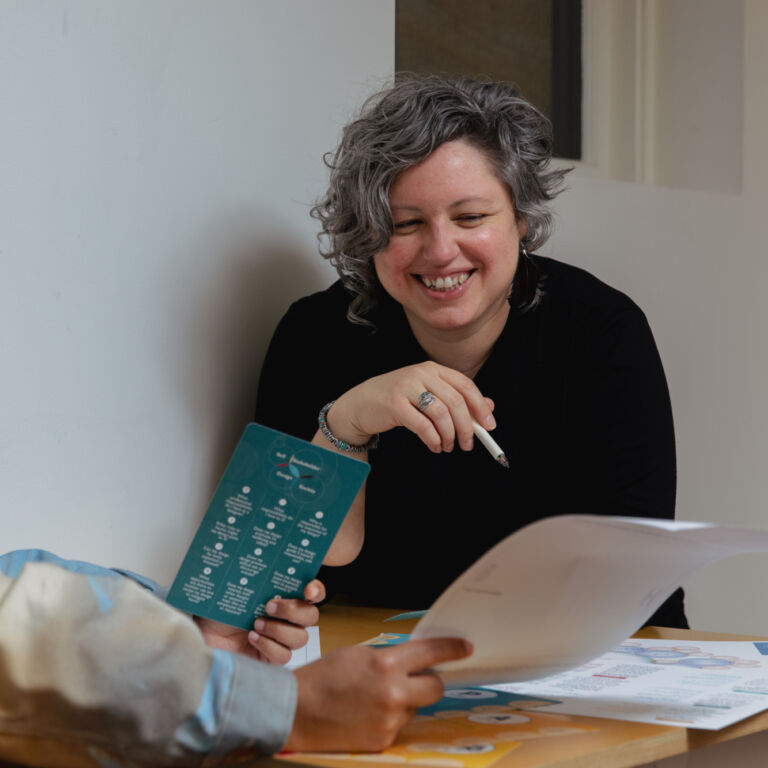
This article by Jennifer A. Reimer, a writer at the McCoy Family Center for Ethics in Society, shares the work of Emma Ruth Duncan, a postdoctoral fellow with joint appointments at the Ethics Center and the d.school, and explores the need for embedding ethics within design education.
Helping students apply ethical reasoning to real-world design challenges
How can ethics become a meaningful part of how designers think—not only after something goes wrong, but as a consistent feature of their creative process?
At Stanford, a collaboration between the McCoy Family Center for Ethics in Society (Ethics Center) and the Hasso Plattner Institute of Design (the d.school) explores this question. Through an evolving partnership, a postdoctoral fellow and faculty have worked across disciplines to incorporate ethical reflection into core design courses—not as an add-on, but as a structural element of how students learn to work through complexity.
At the heart of this collaboration is a deceptively simple idea: what if design students had access to the same ethical frameworks philosophers use, translated into tools for practice?
As Yousef Al-Riyami, ‘26, reflected, design often involves navigating uncertainty. The ethics tools, he noted, “didn’t necessarily simplify that process—but they helped [us] sit with the ambiguity, ask better questions, and surface new paths forward.”
This kind of grappling—the kind that resists easy answers—underscores the broader purpose of the initiative. As Carissa Carter, Academic Director at the d.school, explains:
“Designers have a lot of power. And students want to use that power responsibly to better the world. But when you are creating things that affect people, the planet, our descendants, etc., there is never one correct answer. Integrating ethics across our curriculum gives students a range of ways to make their value systems explicit and see how they feel. It allows them to try on the implications of their design decisions. It gives them a skill set they can bring to their work long after they leave Stanford.”
Rather than supplying predetermined ethical frameworks, the collaboration equips students with practical tools—like values cards and trade-off maps—to support critical inquiry within real-world design challenges. The aim is not to simplify decision-making, but to deepen the process.
A toolkit for ethical imagination: values aren’t just personal—they’re structural
Embedding ethical inquiry into design education starts with the right tools. Emma Ruth Duncan translates that idea into practice through hands-on curricular development. Duncan, who earned her PhD in Philosophy from UC San Diego and her BA in Graphic Design from Portland State University, is a postdoctoral fellow with joint appointments at the Ethics Center and the d.school.
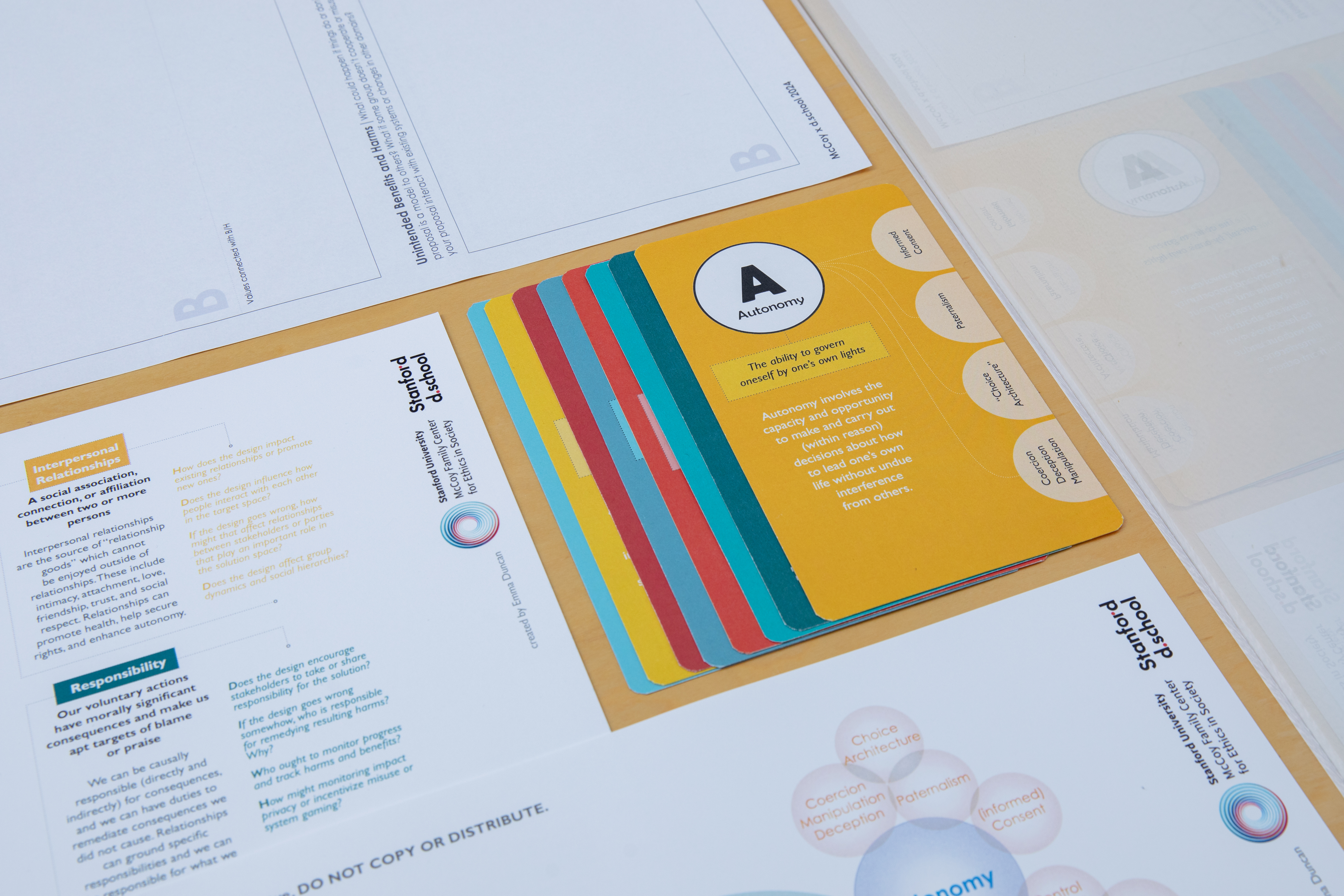
With a focus on trust in fields like public health and AI, her research directly informs her contributions at the d.school. Working closely with faculty, Duncan has been developing ethics modules and materials for multiple design courses across the d.school curriculum—from Design 1 to the graduate-level Design Capstone series. For example, in Design 301: You Are Here: Foundations in Design and Design 360R: Advanced Reflective Practice, these modules include short lectures, decision-making frameworks, and a deck of “values cards”—each representing core moral considerations like justice, dignity, privacy, autonomy, and trust.
It wasn’t just about what could go wrong—it helped us think about what might happen if things go right, and what unintended consequences we might miss if we didn’t slow down and ask deeper questions. —Shawn Smith, '26
“Like all the ethics materials we’ve developed, the value cards are meant to be a starting point for ethical inquiry, not an end,” Duncan explained. “Rather than being a checklist for creating an “ethical design,” the cards serve to scaffold students’ understanding of moral values and exploration of the sometimes subtle ways they can be impacted by a design.” Each card includes a concise explanation of a specific value, along with a series of questions exploring how the design may engage with that value across various contexts—such as user interactions or the design’s impact on broader societal practices and systems.
Students don’t engage with these tools in abstraction. They apply them mid-design, using values maps and harm-benefit worksheets to interrogate decisions within the context of messy, real-world projects. For many, the process reshapes how they think—and what they build.
“Bringing in the ethical lens added another dimension,” observed Shawn Smith, ‘26. “It wasn’t just about what could go wrong—it helped us think about what might happen if things go right, and what unintended consequences we might miss if we didn’t slow down and ask deeper questions.”
That process of slowing down, of anticipating ripple effects, becomes a kind of muscle memory the team can carry into future projects.
Building a culture of ethical reflexivity
By embedding ethics into design curriculum, not as a separate discipline but as an integrated way of thinking, the Ethics Center-d.school partnership helps students see ethical reasoning as part of their academic and professional identity.
I think there’s just more and more interest right now at the student level. Not just in applying frameworks, but in understanding the roots—how different paradigms of ethics can lead to different outcomes. — Al-Riyami, '26
“We want to normalize ethical reflection and deliberation as a core practice across all kinds of work,” Duncan emphasized. “That’s why partnerships like this matter. Design students might never take a philosophy course, but they still want, and need, to grapple with complex moral questions. And they need accessible tools to help them do that.”
Students have echoed this need. Graduate student Anastasha Gunawan, ‘26 described how the tools shaped not only a class project but her broader approach to design: “It’s not realistic for any product to be perfectly ethical. What I appreciated most about the framework was how it helped us think through trade-offs. That’s why I really love the value trade-off worksheet. You’re asked to prioritize a few values while you’re ideating, and then think about what you’re sacrificing as a result. That kind of balancing scale is really helpful because if we’re not going deep into the ethical thinking, it’s easy to just say, ‘Well, we’re prioritizing these, so we’re good to go.’ But it’s not that simple.”
Her experience highlights a larger student interest in not just using tools for ethical reflection, but exploring the philosophical foundations that inform them.
Several described a desire for more opportunities to explore ethical frameworks, and even to study the differences between traditions–utilitarianism, deontology, and Aristotelian ethics.
“I think there’s just more and more interest right now at the student level,” Al-Riyami observed. “Not just in applying frameworks, but in understanding the roots—how different paradigms of ethics can lead to different outcomes.”
These insights reflect a larger shift already underway—not just among students, but across campus. As ethics becomes more integrated into coursework, research, and design practices, the opportunity grows for academic units to collaborate in ways that are both rigorous and responsive. By fostering a culture where ethical inquiry guides how students imagine, build, and reflect, the partnership helps set a new norm–one that measures design not only by innovation but by its impact on people, communities, and the world.
The future is ethically designed—if we build it that way
Ethics can be provocative. It can slow us down. It can even make things messier. But it can also make our work—our designs, our decisions, our collaborations—deeper, more inclusive, and more just.
“We don’t want people to think of us just when things go wrong,” Duncan affirmed. “We want them to think of us when things get complicated.”
Credits
Jennifer A. Reimer is a contributing writer at the McCoy Family Center for Ethics in Society. She is an Assistant Professor of American Studies at Oregon State University-Cascades and a writer-editor. She writes about collaboration, race, migration, and poetry.