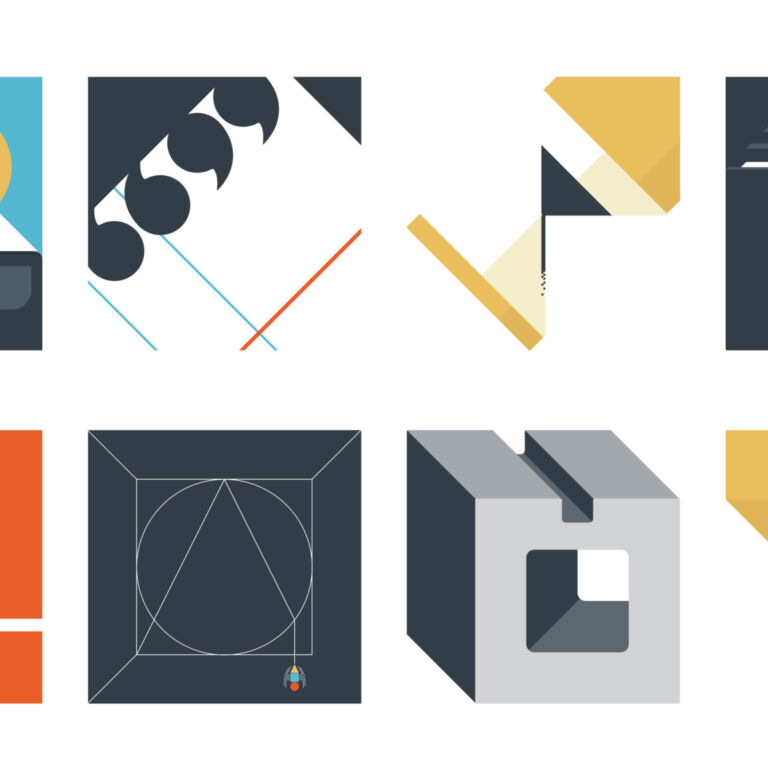
In 2018, the d.school deepened their work with the design abilities, which represent creative competencies that span any one version of a design process. Academic director, Carissa Carter, and creative director, Scott Doorley, looked at the abilities that were more intangible and harder to practice and offered fresh insights on how those abilities can be used. This article, written by Carissa and Scott, explores a new way of thinking about design work.
2018 Is the year of the Intangibles
April 12, 2017 was the first time I was accused of machine learning. It was mid-morning, mid-class at Stanford University’s d.school. Nine graduate students were taking shifts in front of a white board, moving and clustering sticky notes, scanning for connections amongst lessons scribbled upon each. Zoom in, circle a group of like ideas, and write a headline about how they’re related. Zoom out, read the headlines, zoom in, erase and explode a grouping that isn’t working, make a new one. We had a nice flow going. The students were focused. And then, one of my students said, “This is just like machine learning.”
A flush washed over me. I thought about ignoring the outburst. After all, I wanted the students to stay focused on the exercise at hand. I couldn’t. Here we were, a handful of humans, a whiteboard, and a few dozen pieces of paper with hand-written words on them. There were no algorithms in the room. There weren’t even any students that dared respond to a buzz in their back pocket. I couldn’t let something so profound go unchecked.
You see, this is the kind of moment that we live for as educators. A student, fully immersed in a classroom activity, makes a connection that you, the instructor, never considered. Our sticky notes were the data. We put that data on the board and using our initial hunches, began to cluster it. Our bodies and brains worked together to find connections, trying on a range of relationships between the different ideas, getting better and better with time until we landed on a landscape of clusterings that felt insightful — maybe even a little delightful. I’d led our design class in a distinctly in-person synthesis activity, but this student, Austin Hou, recognized that we were essentially acting out the mechanics of machine learning. He’d made a cross-disciplinary connection from the uber-analog to the hyper-digital.
This is also the kind of connection we strive for, particularly at the start of this new year. 2018 is poised to be a collision of possibilities. Political instability, social disparity, racial inequality, and environmental destruction are today’s truths. But at this moment, we also have more agency to create than we’ve ever had. Technology is accessible to more people than ever before to make products, train students, or put new knowledge in the world. The collision of these complex problems with widely attainable tools is our great opportunity. It’s like when two pieces of the Earth’s crust collide and form a new mountain range.
It is our responsibility to prepare students to create for the mountainous complexity of today’s world. So what, then, should we use as the backbone for their preparation? What should we consider as we create the learning experiences for tomorrow’s leaders?
At the d.school, we teach design, often to novices from other departments. We’ve been lucky enough to be on the front lines of the discipline over the last ten years. As we instruct our students, we examine our pedagogy and experiment with how we teach. But as the popularity of design has surged in recent years, there’s been a trend towards commoditization. Take a quick workshop, learn about a process, check a box. These short experiences are great at welcoming in newcomers, but they have contributed to a one-dimensional view of the discipline.
Like many others that offer introductory design workshops, we at the d.school use a step-like process diagram to introduce beginners to our way of working. In ours, each hexagon represents a different set of activities important to innovation.
If you peel back these hexagons, there are four “tangible abilities” that underlie them. They are distinct ways of understanding or modifying, some diverging to new possibilities, others converging towards clarity. Each requires the mind and body to work in a unique, specific way.
Each of the four tangible abilities requires the mind and body to work in a unique way. These four different ways of working are controlled by different parts of your brain.

Synthesizing information with nine students on a whiteboard is a process of converging to understand, and it’s linked to the science of how our brains work. Distinct parts of the brain light up when a person engages in the thinking patterns that drive each of the tangible abilities. When you’re synthesizing information and converging to understand your frontal integrative cortex lights up. If you’re quickly sketching a bunch of ideas, the most rapid way to rapidly experiment, you are diverging to modify and your motor cortex takes over.* All four of these tangibles map to different places in your brain. This in itself is exciting, but it’s just the starting point.
Design incites students to put these tangible abilities to work. Each requires undivided attention and focus to be successful. You don’t take a phone call when you’re in a brainstorm session, rapidly experimenting with potential ideas. And you don’t yell out and accuse your instructor of machine learning when you should be focused and quiet, finding relationships and patterns in your data.
But, Austin did. He broke the flow of what we were doing because of the connection he’d made. He abstracted our design activity and linked it to a concrete method from computer science. He could see the big picture and articulate the details. That’s what we call Moving from Abstract to Concrete. If the first four abilities are the tangibles, this one is an intangible — an ability that doesn’t live squarely in a specific place in your brain, fit precisely in one quadrant of a 2x2 matrix, or sit cleanly within the six sides of a hexagon. An intangible is fluid. It requires the brain to move among and across modes of thinking and making.
These intangible abilities just may be more important than their tangible cousins.
Have you ever tried to balance standing up on two horses at the same time, one leg on each as they gallop through a field? Me neither, but even thinking about it you can get a sense for what it must feel like to maintain balance through the spread of your straddle on the saddles. If one horse drifts you lengthen your split and if the other needs to leap one of your knees needs to bend and accommodate.
The four intangibles require your mind to be equally as fluid and responsive, in both tension and in slack. You must straddle and flex between modes of focus and flare as well as grapple with both processing and making. Here they are:
Move Between Concrete + Abstract

Think specifically about your commute to work. How did it make you feel today? Today, I felt proud and productive on my drive. Why? Those are pretty abstract words to describe a commute. I didn’t do any actual work while driving, but I optimized which lane to be in at every point in the drive to ensure I made it through stop lights and congested stretches of road with maximum efficiency. I doled out my patience. I was calm when I knew I couldn’t move faster and quick and careful when I knew I could gain some ground. Like the cross-campus jump from our white board exercise to machine learning, zooming out to the big picture and then zooming in to the details of how that big picture comes to life is about Moving Between the Abstract and Concrete.
Communicate Deliberately

Deena Rosen, a Stanford product design grad and the one time head of design at OPower, comes to speak in our classes every so often to share the most unassuming and effective examples of good design I’ve seen in awhile. OPower’s mission is at once straightforward and mind-bogglingly complex: get people to use less energy. One of the most mundane yet fascinating ways she helped them do it was though a simple graph that ends up on PG&E power bills. It plainly shows how your power usage compares to your neighbors’ power usage. It is clear and clean and direct.
Seven years in, they helped save 6 Terawatts of energy. That sounds like a lot, and it is — translated into savings by consumers, it’s somewhere in the ballpark of USD $700 million. This is design at its most subtle and simple, and a great example of Communicating Deliberately. Rosen had to understand her audience and the media needed to help shift their behavior towards energy conservation. The output might look simple, but in this case it’s a sign of sophistication.
Being able to Communicate Deliberately is important whether you’re reflecting with your team on a recently completed project or pitching a concept to an investor. You need to know your audience, know the goal of the communication, and be able to set the conditions for its success.
Design Your Design Work

Seamus Harte takes the slow train to work. It takes 52 minutes, though there are plenty of bullet trains that take just 36 minutes to make the same trip. On the train, he listens to the same playlist he played the day before, the same one he’ll play the day after. It runs 52 minutes. He scribbles in an 8.5”x11” journal with a hard, black cover and blank pages — no lines. He fills it with marks from a black, felt-tipped, medium point, Paper Mate Flair pen. He’ll use this same journal every day until it is full. After that, he’ll use a fresh 8.5”x11” journal with a hard, black cover and blank pages — no lines. And he’ll fill it with a medium point Flair pen.
From my angle, Harte’s routine is as precise as a pro ballplayer getting ready to bat. Step by step, he methodically works through ideas that he’s been noodling on since the night before. Meanwhile, a transition between songs on his playlist lets him know it’s time to move to the next idea. I’ve known Seamus Harte for about four years, from when he was a d.school and filmmaking graduate student to his current work as a practicing media and story designer.
Harte’s routine is honed over time. If he feels good and the work is strong, he’ll replicate the routine precisely for months in a row. If any of it feels off — if a song distracts or gets stale — he’ll change it the next day. This train ride is the moment when he’s most creative, when he comes up with his most novel and meaningful ideas. He’s Designing his Design Work (or just Designing his Work). He knows exactly the conditions, tools, and people (or lack of people) needed to support his productivity. Being able to scope a challenge and design the conditions to make yourself successful with it takes time, practice, and patience. It’s unique to individuals and required for teams.
Navigate Ambiguity

“Is it too late to run an eviction help workshop?” was the subject of an email that I received from Margaret Hagan tonight. A lawyer and designer, Hagan was a d.school fellow three years ago and now runs the Legal Design Lab at Stanford Law School. Eviction, like many aspects of the law, is an ambiguous process. Hagan, unlike many people in the law, works tirelessly to create design interventions that help people get clarity in a blurry system.
However, whether or not you’re being evicted, it’s no secret that most of the big challenges in society today are big and messy. We exist in an interconnected ecosystem of humans, systems, organizations, and the environment. And we believe that our students should begin tackling them before they leave university.
You’re likely dealing with some degree of ambiguity on any project, no matter the challenge. So, what does it mean to embrace ambiguity? It means allowing and even encouraging multiple ideas or paths for a project to exist in parallel. It means suspending our natural human tendencies to find resolution or construct an answer right away. It means recognizing your personal response to ambiguous circumstances, letting yourself simmer in its delicious stew, and developing techniques to find your way out when necessary.
These four intangibles — Move Between Concrete and Abstract, Communicate Deliberately, Design your Design Work, and Navigate Ambiguity — are important learning goals for our design courses. Combined with the tangibles, these comprise our 8 design abilities. Defining design by abilities does two things: it emphasizes what students are learning, and recognizes the habits they are developing. Our intention in framing design as a set of learnable abilities is to open up the potential to shape our thinking — and shape our world — right now, when it matters most.
For us, the Intangibles are the most interesting bit. Though they don’t find their way into the hexes or most design process diagrams, we actively teach them in several classes. They round out the designer and perhaps define design — what do designers do but navigate ambiguity? — yet they are also the most elusive to pin down. For this reason, when a student has a well-founded machine learning accusation, the best thing to do is stop and let him reason it out.
The Intangibles leave plenty of room for anxiety. But they give room for opportunity too. Activist movements, social services, resource-sharing platforms, reconsidered schools, medical programs, work spaces, household goods, and even DNA are just a few of the things that we as individuals have the tools to create, but it none of it works without the intangibles.
The zoom-in, zoom-out motion between abstract and concrete pulls a great idea from one domain to create traction in another. Deliberate communication cuts through the web of opportunity and distractions we all face, all the time. Designing not just what we work on but how we work on it helps us adapt to our shifting contexts as they quake — and they will quake. Ultimately, the way these abilities — tangible and intangible alike — really add up is to prepare us to navigate through this peculiar moment in history, the start of 2018. We are, truly, in the age of ambiguity.
Similar to the way building codes and zoning laws shape the expression of a city, design education sets a pattern that finds its way into the designs that shape our experiences everywhere in life. We have no expectation that a student designer needs to master each ability, simply that these are the traits that lead to a design approach that preserves both aesthetics and ethics and is accessible to those who choose to pursue it.
Let’s celebrate the opportunity of the new year. Here’s to the brilliance of student interruptions and two-horse straddles, and to the intangible wonders of design as we use it navigate this age of ambiguity together.
Appendix 1 of 2
*The connections between experiential learning and design process are well-documented in:
S.L. Beckman and M. Barry, Innovation as a Learning Process: Embedding Design Thinking, California Management Review, Fall 2007, Volume 50, №1.
Of particular note, experiential learning process and models originate from:
D.A. Kolb, Experiential Learning: Experience as the Source of Learning and Development Prentice- Hall, 1984.
and
A.Y. Kolb and D.A.Kolb,The Kolb Learning Style Inventory — Version 3.1 Technical Specifications; Hay Group, 2005.
Links between experiential learning and different portions of the brain are made by:
J.E. Zull, The Art of Changing the Brain: Enriching Teaching by Exploring the Biology of Learning (Sterling, VA: Stylus, 2002).
The research done for this article builds on the foundations of the above.
Illustrations of the 8 Design Abilities are by Jason Munn. www.jasonmunn.com
Appendix 2 of 2
Here’s a bit more context on the four tangible design abilities:
Empathize + Test → Learn from Others (People and Contexts)

Get out into the world, study the particulars of the situation you’re designing for, explore analogous parallel contexts, talk to people, shadow and interview them, spend time understanding real human needs. Try out your ideas with actual people and even have them step into life-sized models of the experiences you’re building. Learning from Others puts the human in human-centered design and puts those same humans into the larger systems they interact with.
Define → Synthesize Information

Sort, re-sort, framework, and map data in order to find connections and reveal patterns. Combine disparate pieces of information into a coherent idea. Find an insightful frame to the problem you’re tackling. Use metaphors to help clarify how a system functions. Zoom in and out of a whiteboard like you’re a human doing machine learning. This is what it takes to Synthesize Information.
Ideate + Prototype + Test → Rapidly Experiment + Build and Craft Intentionally

Bring some ideas to life in the quickest way possible — sketches, quick and dirty models, storyboards, lightly scripted experiences — anything to get an idea into the world so it can be tested, played with, and modified. Rapidly Experiment covers a few of the hexes. It is a pretty straightforward concept. “Build to think” is a nice moniker for this ability. Make things to see what you can learn from them.
And then there’s the art of translating intention into material, and imbuing experiences with meaningful detail. Build and Craft Intentionally is a cornerstone of design work and a domain in itself. It finds its way into all aspects of design, but becomes particularly important when ideas start to get tangible.
Essentially, every sub-discipline of design comes with myriad creation tools, whether you’re building an app or a classroom or a new form to request a copy of your social security card. For each of these solutions, the fields of UX design, architecture, or graphic design offer a lifetime’s worth of technique to Build and Craft Intentionally.
Credit
Original art by Jason Munn